By Rohan Mehta · Checked 7 October 2026
HyroTrader sells three ways to reach the same funded account. They differ in price, in how much drawdown you are given, and in how fast you can finish — and the fastest is neither the cheapest nor the most generous once you pass.
HyroTrader Zero-Step, One-Step and Two-Step side by side
| Feature | Zero-Step | One-Step | Two-Step |
|---|---|---|---|
| Badge on the firm’s site | “New” · Fastest Route | “Most Popular” | Lowest-Cost Route |
| Phases | 1 | 1 | 2 |
| Profit target | 10% | 10% | 10% then 5% |
| Maximum loss | 5% | 6% | 10% |
| Daily loss | 3% | 4% | 5% |
| Consistency rule | 50% per trade | 40% per day | 40% per day |
| Minimum trading days | 1 | 5 | 5 + 5 |
| Charge | Non-refundable fee | Refundable deposit | Refundable deposit |
| Price at $100,000 | $949 | $749 | $579 |
| Largest funded account | $100,000 | $200,000 | $200,000 |
| Profit split | 80%, fixed | 80% → 90% | 80% → 90% |
Rules from HyroTrader’s product cards; prices from the start-trading page’s product data. Both read 7 October 2026.
Two-Step: the widest drawdown rules, the lowest price
Two-Step gives a 10% maximum loss — double Zero-Step’s — and a 5% daily limit, for the lowest price at every account size. The cost is structural: two phases, a 10% profit target then a 5% target, and a minimum of five trading days in each, so ten trading days before a funded account is possible.
In money, on a $50,000 account, that 10% is $5,000 of room against Zero-Step’s $2,500, for $379 instead of $629. A trader whose challenges usually end on a drawdown breach rather than a failure to reach target should read that line twice: the route that fixes the problem is also the cheap one.
It suits a trader whose edge needs room and who is not in a hurry — a swing trader holding positions through crypto’s overnight volatility, or anyone sizing conservatively and grinding toward the target. The second phase’s lower 5% target is easier than the first, so the difficulty is front-loaded.
One-Step: the middle route, and the default for most traders
One phase, a 10% profit target, a 6% maximum loss and a 4% daily limit, five minimum trading days, a refundable deposit, scaling to $200,000 and to a 90% split. HyroTrader badges it “Most Popular” and it is the sensible default: one target to clear, limits that are not punishing, and $170 less than Zero-Step at $100,000.
The case for One-Step over Two-Step is time and simplicity — one target instead of two, five minimum trading days instead of ten. The case against is the drawdown: 6% rather than 10%, which in crypto is a meaningful narrowing, for $170 more at $100,000.
Zero-Step: speed, priced — and no payout upside
One trading day minimum. Pass in a session and move on. In exchange:
- The tightest risk limits: 5% maximum loss, 3% daily — the smallest margin for error of the three, on the route where you have the least time to recover from a bad start.
- The highest price: $949 against Two-Step’s $579 at $100,000, a 64% premium.
- The money is a fee, not a deposit. It does not come back. Every account size and what it really costs works through what that does to the real gap.
- A $100,000 ceiling, where the other routes reach $200,000.
- 80% profit split, permanently. The 90% increase is available only on One-Step and Two-Step, so Zero-Step costs the most and pays the least on every withdrawal thereafter — see the payout terms.
Zero-Step also carries the tightest version of the consistency rule: no single trade may count for more than 50% of the profit target, so the 10% cannot be made in one position.
The combination is worth stating plainly: the newest product is the most expensive, the most restrictive on risk, the most limited in account size and the only one that caps your split. The one thing it does better is finish quickly.
Daily drawdown in dollars, by funded account size
The percentages differ by route, and in money the spread is wide:
| Account size | Two-Step daily (5%) | One-Step daily (4%) | Zero-Step daily (3%) |
|---|---|---|---|
| $5,000 | $250 | $200 | $150 |
| $10,000 | $500 | $400 | $300 |
| $25,000 | $1,250 | $1,000 | $750 |
| $50,000 | $2,500 | $2,000 | $1,500 |
| $100,000 | $5,000 | $4,000 | $3,000 |
| $200,000 | $10,000 | $8,000 | not offered |
Arithmetic applied to HyroTrader’s published daily drawdown rules, 7 October 2026.
On a $50,000 account the daily limit is $2,500 on Two-Step and $1,500 on Zero-Step. Both routes ask for the same 10% profit target. Paying more for Zero-Step buys you a third less daily room to reach an identical goal — which is the argument against it in one line.
Trading platforms, real order books and real market data
Every route gives the same access: your own Bybit demo account by API with 700+ USDT perpetual pairs at up to 100x, your own BloFin demo account with 80+ USDT-M futures pairs at up to 150x on BTC and ETH, HyroTrader’s own Hyro platform needing no exchange account, or the Tealstreet and Tiger.com terminals running on Bybit market data.
This is the part of the offer that most distinguishes a crypto-native prop firm from one that bolted crypto onto an existing product. Your challenge runs against live exchange market data and the liquidity of real order books rather than a price feed the firm models itself. The accounts are still simulated — HyroTrader says so plainly — but the market they simulate is the one you would actually be trading, and the fills reflect real book depth rather than a synthetic spread.
Because none of this varies by route, platform choice should not enter the Zero-Step versus One-Step versus Two-Step decision at all. It is purely price, drawdown, speed and ceiling.
Profit split, payout and scaling after you pass
The routes stop being equivalent the moment you are funded:
| Feature | Zero-Step | One-Step | Two-Step |
|---|---|---|---|
| Starting profit split | 80% | 80% | 80% |
| Maximum profit split | 80% | 90% | 90% |
| Largest funded account | $100,000 | $200,000 | $200,000 |
| Deposit refunded | No | Yes, with first payout | Yes, with first payout |
A trader who passes Zero-Step is locked at 80% for the life of that account. The same trader on Two-Step keeps 80% initially with 90% available for consistent performance — on every withdrawal, indefinitely. On a funded account producing $2,000 a month, ten points of split is $200 a month, which overtakes the $370 price gap inside two months. How withdrawals and the split work covers how and when the split moves.
Verify HyroTrader’s trading rules before you buy
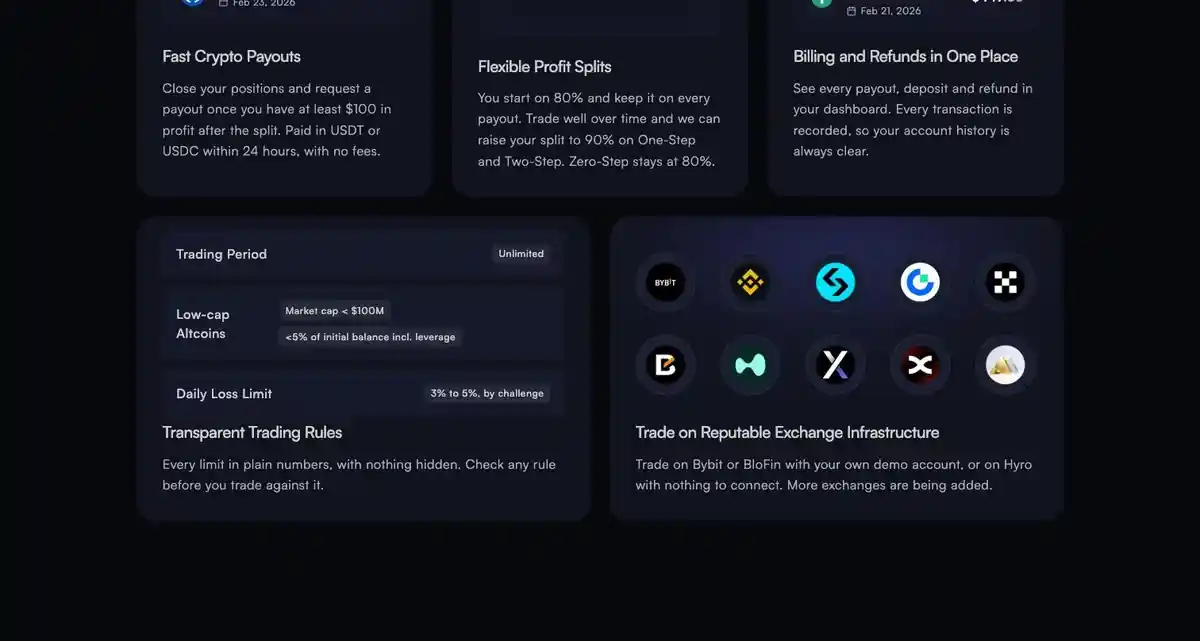
Every figure above is on HyroTrader’s own pages and takes two minutes to re-read:
- Open the start-trading page and compare the three product cards — maximum loss, daily loss, profit target, minimum evaluation period and whether the charge is a deposit or a fee are all printed on them.
- Scroll the homepage to the rules section for the funded-phase table and the 30-day inactivity rule.
- Check the date on any third-party page telling you something different.
Rules change, particularly on a product the firm itself badges “New”. This page was checked on 7 October 2026; if a figure here no longer matches the firm’s own card, the firm’s card is right and a note to the editor gets this page fixed.
What Trustpilot reviews suggest about each route
Trustpilot gives HyroTrader 4.0 from 228 reviews, and while reviewers rarely name their route, the themes map onto the rules above.
Traders describe passing on small accounts and taking a first payout — the $5,000 tier, where Two-Step at $59 is the obvious entry point. They praise the absence of a cap on the number of trades, which follows directly from the published trading rules: no maximum trade count and no deadline. A consistency cap does apply — 40% of the target per day, or 50% per trade on Zero-Step — but it limits how much one session counts for, not how often you trade. And the recurring complaint is the low-cap altcoin rule, which applies regardless of route and is the one restriction a trader is most likely to meet without having read it first.
What the reviews do not show is anyone reporting that the drawdown rules differ from the published figures, or that a payout was refused on a technicality. For a prop firm, the absence of that particular complaint across 228 reviews is more informative than the average score.
Which HyroTrader route fits which trading style
- Lowest total cost, most forgiving drawdown: Two-Step. Cheapest at every size, widest risk limits, deposit returned with your first payout. The default recommendation for most traders.
- Balanced, one target: One-Step. Middle price, workable limits, full $200,000 ceiling, 90% split in reach, half the minimum trading days of Two-Step.
- You want it finished this week: Zero-Step, understanding you are paying a 64% premium for a product with tighter limits, a lower ceiling, a capped split and no refund.
A fourth consideration cuts across all three: account size. A $5,000 Two-Step at $59 is a cheap way to test whether you can clear a 10% target inside a 10% drawdown at all, and the answer transfers to the larger sizes, where the same percentages apply to bigger numbers. Buying the biggest account you can afford on the first attempt is the common and expensive mistake.
The consistency rule: 40% a day, or 50% a trade
HyroTrader does publish a consistency rule, and it is easy to miss because of what it is called. On all three product cards the row labelled “Profit distribution” reads “Yes”, and that row is the consistency rule. The firm’s own description: it “caps how much of your profit target can come from one trading day or one trade, depending on the challenge.”
The numbers differ by route:
- Zero-Step — 50% per trade. “No single trade may count for more than 50% of your profit target during the evaluation phase.”
- One-Step and Two-Step — 40% per day. “No single trading day may count for more than 40% of your profit target during the evaluation phases.”
In both cases the firm states that profit above the cap stays in your account but does not count toward the target. You do not lose it and you are not breached for exceeding it; it simply does not advance you, so the remainder of the target has to be made on other days or in other trades.
This is the rule most worth understanding before you buy, because it decides whether a strategy can pass at all. On a One-Step $100,000 account the 10% target is $10,000, so no single day may contribute more than $4,000 of it. A strategy whose edge is one large move a month will keep the profit and still fail the evaluation. On Zero-Step, where the minimum evaluation period is a single day, the per-trade cap of 50% means the target cannot be reached in one position — at least two winning trades are required by construction.
Read next to the drawdown limits, this is what the three routes really ask: make 10% without losing 5-10%, and without any one day or trade carrying more than half of it.
What is identical across all three crypto prop firm routes
Several things do not change with route, and they matter when comparing crypto prop firms:
- Platforms. Hyro, Bybit by API, BloFin by API, Tealstreet and Tiger.com are available on every route.
- Instruments. 700+ crypto pairs on Bybit and the firm’s own platform; 80+ USDT-M futures pairs on BloFin; leverage up to 100x, or 150x on BloFin’s BTC and ETH.
- Payout terms. USDT or USDC, within 24 hours, no fees, $100 minimum after the split.
- No stop-loss requirement, and an unlimited trading period.
- The 30-day inactivity rule, which closes any account that goes untraded for a month.
So the route decision is purely about price, drawdown, speed and ceiling. Everything else is the same product.
Frequently asked questions
Which HyroTrader challenge is cheapest? Two-Step, at every account size — from $59 at $5,000 to $969 at $200,000.
Is Zero-Step worth the extra cost? Only if finishing in a day is worth more to you than $370, a wider drawdown, a $200,000 ceiling and a 90% split. Our full verdict on HyroTrader takes the view that for most traders it is not.
Can I upgrade from Two-Step to One-Step? HyroTrader’s public pages describe no upgrade path between routes. Choose at purchase.
Which route reaches a 90% profit split? One-Step and Two-Step. Zero-Step is fixed at 80%.
Do all three routes use the same trading platforms? Yes — Hyro, Bybit, BloFin, Tealstreet and Tiger.com, regardless of route.
Are the drawdown rules the same once funded? On Zero-Step, yes: 3% daily and 5% maximum carry into the funded account. HyroTrader does not render the equivalent funded tables for One-Step and Two-Step on its public page, so this site does not state them. Our checks on the company list what else could not be verified.
Is there a discount for choosing a particular route? No. The prices are the same for everyone, and HyroTrader publishes no discount code.