By Rohan Mehta · Checked 7 October 2026
HyroTrader pays funded traders in USDT or USDC, within 24 hours of a request, with no fees. In a market where a large share of traders cannot easily receive a bank wire, that is the most consequential thing about the firm, and it is published plainly on its own homepage.
HyroTrader payout rules in full, 2026
| Term | What HyroTrader publishes |
|---|---|
| Currency | USDT or USDC |
| Processing time | Within 24 hours |
| Fees | None |
| Minimum withdrawal | $100 in profit after the split |
| Condition | Positions closed before requesting |
| Frequency | On demand |
| Starting profit split | 80% |
| Maximum profit split | 90% on One-Step and Two-Step; Zero-Step stays at 80% |
All read from HyroTrader’s own homepage on 7 October 2026.
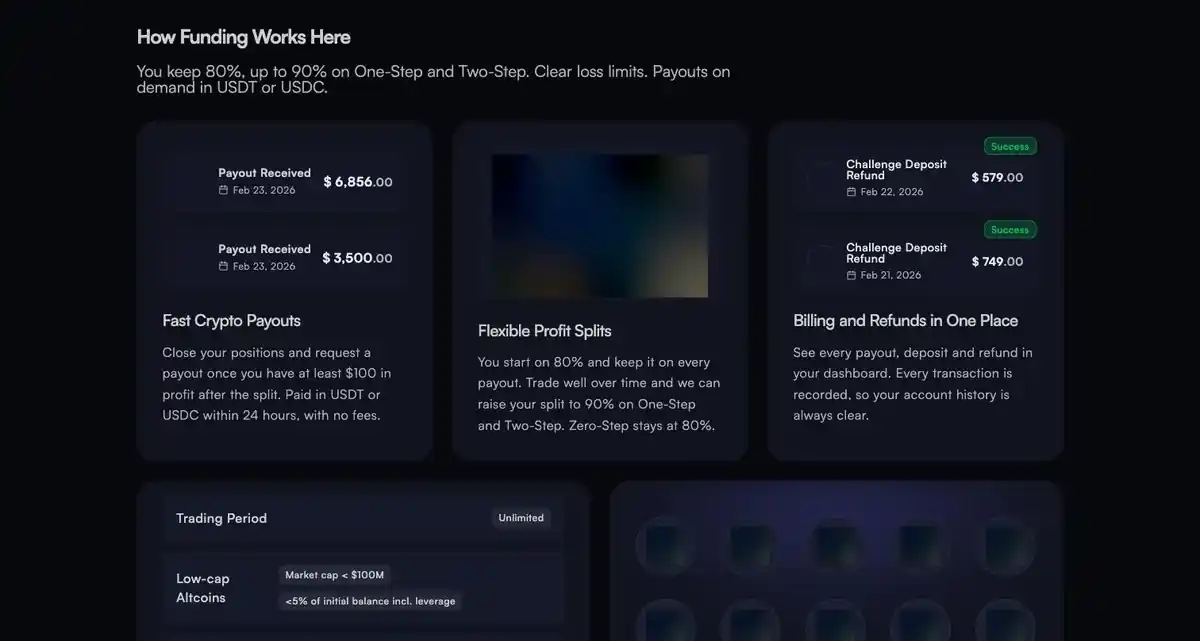
Three of those rows are unusual for a crypto prop firm. On demand means there is no payout cycle — no waiting for a biweekly or monthly window, which is the norm across proprietary trading more broadly. No fees means the figure you request is the figure that arrives. And within 24 hours is a published commitment rather than a vague “fast payouts” claim.
How the profit split works for funded crypto traders
Everyone starts at 80% and keeps it on every payout. HyroTrader’s wording is that consistent traders “can” be raised to 90% on One-Step and Two-Step. Read that as discretionary: there is no published ladder of thresholds — no “three profitable months and the split increases” — so a trader should price the account at 80% and treat 90% as upside.
Zero-Step is excluded entirely and stays at 80% permanently, which is one more reason the fastest route is the weakest deal once you are funded rather than evaluating.
The arithmetic of the minimum withdrawal catches people out. The $100 minimum is measured after the split, so at 80% you need $125 of gross trading profit before you can request anything. On a $5,000 funded account that is 2.5% of the account; on $100,000 it is a rounding error. Small accounts reach their first withdrawal more slowly than the headline suggests.
The challenge deposit refund and the evaluation structure
On One-Step and Two-Step, the challenge deposit is returned with your first payout — not at the moment you pass the evaluation. Two consequences follow.
First, the refund depends on reaching a payout. A funded account that never produces $100 of post-split profit never returns the deposit. The money is at risk until the first withdrawal clears, not until the challenge is passed.
Second, your first withdrawal is larger than your trading profit alone, because the deposit rides along with it. HyroTrader’s own dashboard illustrations show deposit refunds of $579 and $749 — exactly the $100,000 Two-Step and One-Step prices from the cost table, which is a useful confirmation that the refund is the full charge rather than a partial credit.
Zero-Step has no refund at all: its charge is a fee, and the firm’s rules table records it as “No refund”.
Drawdown rules and trading rules that can stop a withdrawal
The two loss limits that end a challenge also apply to the funded account. On Zero-Step — the one route whose funded-phase table HyroTrader renders in full on its public page — the funded account carries the same 3% daily drawdown and 5% maximum loss as the challenge itself. A funded account is not a relaxed version of the test, and breaching a limit on a funded account ends it with whatever profit had not yet been withdrawn.
That single fact argues for withdrawing early and often rather than compounding, which is exactly what on-demand payouts with no fees and a $100 minimum are designed to allow. A trader who banks $150 at a time is converting simulated profit into settled stablecoin at every opportunity; a trader who waits for a large round number is leaving it exposed to a drawdown breach.
Two further rules bear on getting paid:
- The 30-day inactivity rule. Stop trading for 30 days and the account closes. An account that closes stops producing payouts and, on One-Step and Two-Step, may take an unrefunded deposit with it.
- The low-cap altcoin rule. Stated on the homepage in plain numbers: coins under $100M market cap are capped at under 5% of initial balance, including leverage. HyroTrader’s September 2026 Trustpilot reply explains it as managing liquidity and execution risk as traders scale. If your edge is in thin altcoin markets, read this one before buying a challenge.
Account size and a realistic first payout
The $100 minimum is measured after the split, so the gross profit needed is $125 at 80%. Against each account size HyroTrader sells, that is:
| Funded account | Gross profit needed for a first payout | As a share of the account |
|---|---|---|
| $5,000 | $125 | 2.50% |
| $10,000 | $125 | 1.25% |
| $25,000 | $125 | 0.50% |
| $50,000 | $125 | 0.25% |
| $100,000 | $125 | 0.13% |
| $200,000 | $125 | 0.06% |
Calculated from the firm’s published $100 post-split minimum and 80% starting split.
The minimum is fixed in dollars, so it scales away to nothing on the larger accounts. On a $200,000 account a single good position clears it; on $5,000 you need a 2.5% gain first. For small accounts the practical consequence is that your first withdrawal and your challenge deposit refund arrive later than the headline terms imply.
Bybit, BloFin and where the payout is earned
The profit you withdraw is earned on whichever platform you chose at the start, and HyroTrader lets you keep your own: a Bybit demo account by API with 700+ USDT perpetual pairs, a BloFin demo account with 80+ USDT-M futures pairs, the firm’s own Hyro platform, or the Tealstreet and Tiger.com terminals. Leverage runs up to 100x, or 150x on BloFin’s BTC and ETH.
None of that changes the payout terms — they are identical across every platform and every account size — but it does change how reliably you can hit them. Trading a familiar order ticket on familiar market data is the difference between an edge that survives the evaluation and one that does not.
Payout proof: on-chain transaction IDs, and what they are worth
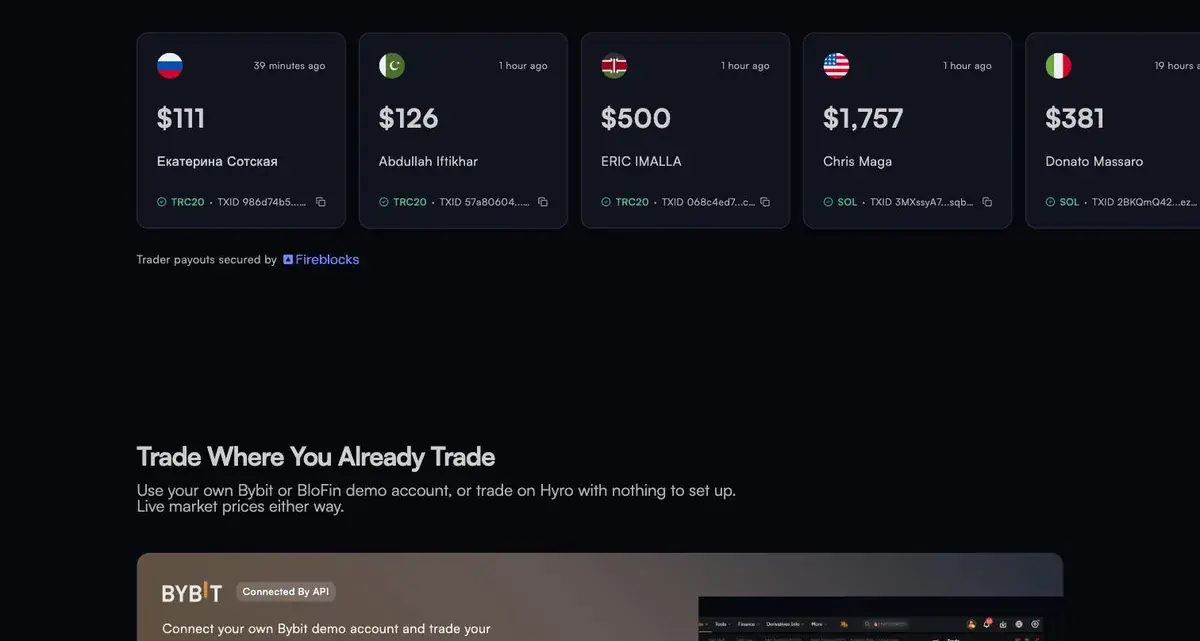
This is the strongest evidence HyroTrader offers, and it is unusual in this industry: a live feed of recent payouts where each entry carries a chain and an on-chain transaction ID — TRC20 and Solana in the capture above — alongside the amount, the trader’s name, their country and a timestamp. The payouts visible when this page was checked ranged from $111 to $1,757, with the most recent posted 39 minutes earlier. The feed also states that trader payouts are secured by Fireblocks, a third-party digital-asset custody provider.
A transaction ID is checkable by anyone, on a public block explorer, without the firm’s cooperation. That does not prove the recipient is the named trader or that the payment relates to a funded account, and nothing stops a firm from publishing selective examples. But it is a far stronger class of evidence than an unaudited cumulative total, and it is the first thing to verify if you want to satisfy yourself that a crypto prop firm settles what it owes.
What else HyroTrader publishes, and what it is worth
Two different things on HyroTrader’s homepage are easy to confuse. The live payout feed is the one described in the section above: real entries carrying a chain, a transaction ID, a country and a timestamp, which were $111 to $1,757 and as recent as 39 minutes old when this page was checked. Separately, the “How Funding Works Here” and “Billing and Refunds in One Place” panels use static illustrations — fixed figures of $6,856 and $3,500 dated 23 February 2026, and deposit refunds of $579 and $749 dated 22 and 21 February. Those do not update; they are artwork. Alongside both, the firm publishes a cumulative $8M+ paid to traders and 1.7K+ funded traders.
How much weight should a crypto trader give that? Some, with limits clearly understood:
- It is self-published. No auditor stands behind the feed or the totals, and a payout feed is a marketing surface on every prop firm site that has one.
- The live feed is specific, and specificity is checkable. Entries carrying a chain and a transaction ID can be looked up by anyone, which is a different class of claim from a round “we have paid millions”. The static panels are worth less as evidence, though the deposit refunds they illustrate — $579 and $749 — match the published $100,000 Two-Step and One-Step prices exactly, which is at least internally consistent.
- It is corroborated weakly but independently. Trustpilot reviewers in September 2026 describe first payouts arriving, including one trader’s first payout after years of failed challenges at other firms.
Treat the feed as consistent with a firm that pays, not as proof of it. The legitimacy page sets out the full evidence and its gaps.
Taxes, wallets and the practical side of a crypto payout
Two practical points that follow from being paid in stablecoin rather than fiat, neither of them HyroTrader’s rules but both part of the experience:
You need a wallet that accepts USDT or USDC, and you are responsible for giving the correct address and network. A stablecoin transfer to a wrong address or an unsupported chain is not reversible by the firm or anyone else. This is the one irreversible step in an otherwise forgiving process, and it is worth sending a small first payout to confirm the route before a large one — the $100 minimum makes that cheap to do.
A payout is income wherever you live. Prop firm profit shares are generally taxable, and receiving them in stablecoin does not change that; it changes only how easy the record-keeping is. HyroTrader’s dashboard lists every payout, deposit and refund, which is the record you will want. Nothing on this site is tax advice, and the treatment of a crypto profit share varies enough by country that it is worth asking someone local.
Evaluation to first payout: the timeline in practice
Putting the published rules in order, the fastest honest route from payment to stablecoin in a wallet looks like this.
Two-Step. Five minimum trading days in phase one to make 10%, five more in phase two to make 5%, then a funded account. The earliest possible first withdrawal is ten trading days of evaluation plus however long $125 of gross profit takes, plus up to 24 hours of processing. The deposit comes back in that same first payout.
One-Step. Five minimum trading days to make 10%, then funded. Half the evaluation structure of Two-Step for $170 more at $100,000, with a 6% rather than 10% drawdown allowance.
Zero-Step. One minimum trading day to make 10% inside a 5% maximum loss, then funded at a fixed 80% split with nothing refundable. Quickest to a first payout, and the only route where the money you paid never comes back.
None of the three imposes a deadline — the trading period is unlimited — so these are minimums, not schedules. The only rule pushing the other way is the 30-day inactivity closure.
Account history, refunds and what the dashboard records
Every payout, challenge deposit and refund is listed in the HyroTrader dashboard, which the firm presents as a single billing and transaction history. For a funded trader that record answers two questions that come up repeatedly in crypto prop trading: whether a deposit refund has actually been issued, and what the account has paid out across its life.
It is also the only transaction record you will have. A stablecoin transfer carries no reference beyond the on-chain transaction itself, so a trader who wants a clean history for their own accounts should export or screenshot the dashboard as they go.
Why stablecoin withdrawals matter in crypto prop trading
Prop firms serving forex and futures traders generally pay by bank transfer or a payment processor. Each step adds a fee, an identity check and a delay, and for traders in the markets where prop firm demand is strongest, a bank wire can be the hardest part of the whole arrangement.
Paying in USDT or USDC removes that layer. The payout lands in a wallet, in a dollar-denominated asset, on the same chain rails the trader is already using for everything else. Combined with the on-demand frequency and the absence of fees, it is the strongest part of HyroTrader’s offer and the reason the review rates the firm as highly as it does despite the pricing.
What it is not: a guarantee. All accounts are simulated, the profit is a contractual share of simulated performance, and the firm’s published payout totals — $8M+ paid, 1.7K+ funded traders — are its own unaudited figures. The legitimacy page takes that seriously. For what a discount code can and cannot change about any of this, start at the homepage.
Frequently asked questions
How long does a HyroTrader payout take? Within 24 hours of the request, per the firm’s own homepage.
What is the minimum HyroTrader withdrawal? $100 in profit after the split — so $125 gross at an 80% split.
Does HyroTrader charge payout fees? No. The firm states payouts are made with no fees.
Can I be paid in something other than USDT or USDC? Those are the only two currencies named on HyroTrader’s public pages.
When do I get my challenge deposit back? With your first payout, on One-Step and Two-Step. Zero-Step’s charge is a non-refundable fee.
Do I need to close positions to withdraw? Yes. Positions must be closed before a payout request.
How often can I withdraw? On demand, as long as you meet the $100 post-split minimum each time.
Does the profit split increase automatically? No. The increase to 90% is described as available to consistent traders on One-Step and Two-Step, with no published thresholds, and is not available on Zero-Step at all.