By Rohan Mehta · Checked 7 October 2026
HyroTrader is a real, identifiable company with a public team, a claimed Trustpilot profile and consistent published terms — and it says openly that all its accounts are simulated. That last point is the one worth understanding before any other.
What this crypto prop trading firm discloses about itself
From HyroTrader’s about page, read 7 October 2026:
- Founded 2023, with the team building from 2022. Based in Prague, with a Google Maps business listing the firm links from its own footer.
- Named leadership: Samuel Drnda (CEO), plus heads of trading, product and risk strategy, frontend engineering and client success. Named people with public roles are harder to fake than a logo, and easier to check.
- Its own counters: $8M+ paid to traders, 35K+ traders registered, 1.7K+ funded traders, 30+ team members, 140+ countries served, 3 exchange integrations.
- The disclosure that matters: “All accounts are simulated (demo) accounts that run on real market data.”
Those counters are the firm’s own and are not independently audited. They are repeated here as claims, not as established fact, and that distinction is the whole point of a legitimacy check.
Why a simulated funded crypto account is not the same as a scam
Nearly every prop firm of this kind operates on simulated accounts. You trade a demo environment and the firm pays a contractual share of the performance you produce. The firm’s revenue comes from challenge charges and from traders who breach their limits; its cost is paying out the traders who do not. That is the business model across proprietary trading, not a HyroTrader peculiarity.
What varies is how plainly it is said. Firms that imply you are trading real exchange liquidity, or that blur the line with talk of “real capital”, are the ones to be careful with. HyroTrader states the position on its own about page, in its own words.
That candour tells you what the product is: a performance contract, not a brokerage account. Your money is the challenge charge; your upside is a share of simulated profit, settled in stablecoin. It also reframes the exchange-integration feature — running your challenge on your own Bybit demo account means the simulation is Bybit’s market data rather than a model the firm built, which is a genuine answer to the oldest complaint in crypto prop trading, that fills are worse on the firm’s platform than they would be on a real exchange.
The Trustpilot record: HyroTrader reviews and payout reports in 2026
HyroTrader’s Trustpilot profile, read 7 October 2026:
| Signal | What the profile shows |
|---|---|
| Rating | 4.0 out of 5 |
| Reviews | 228 |
| Profile | Claimed, since July 2023 |
| Subscription | Paid, disclosed on the page |
| Category | “Educational Institution” |
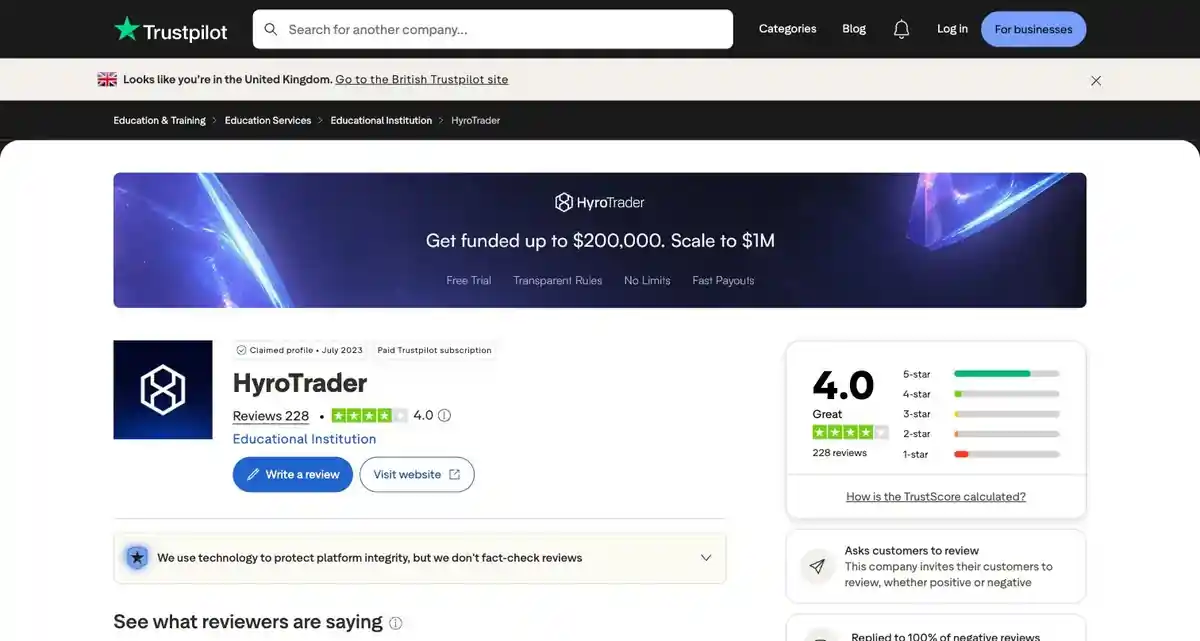
Four things to read carefully rather than at a glance:
- 4.0 from 228 reviews is a moderate sample. Enough to be meaningful, not enough to be conclusive. A firm with tens of thousands of reviews is a different class of evidence, and a 4.0 average means a real minority of unhappy traders sits underneath it.
- The profile is claimed and the subscription is paid. Trustpilot discloses both on the page. A paid subscription gives a company tools to invite reviews, which tends to lift an average; it does not let a company delete reviews it dislikes. Worth knowing, not damning.
- Trustpilot states on the page that it does not fact-check reviews. Its own caveat, printed on its own page.
- The category is “Educational Institution”, not a financial one. That is consistent with a simulated-account model, and it is also a reminder that the firm is not listed, or regulated, as a financial services business.
HyroTrader replies publicly to critical reviews. In a September 2026 exchange a trader who had just taken a first payout complained about the low-cap altcoin rule, and the firm explained the rule’s purpose — liquidity and execution risk — rather than deleting the complaint or answering with a template. Specific public replies to criticism are a reasonable signal about how a company behaves when something goes wrong.
The themes in recent reviews are consistent with the terms published elsewhere on this site: first payouts arriving, no limit on the number of trades, and friction with the low-cap rule. Nothing in them contradicts the firm’s own documentation, which is itself a check worth running.
Trustpilot also reports two behavioural facts about the profile, on the profile itself: HyroTrader has replied to 100% of negative reviews, typically within a week, and it invites customers to review, whether positive or negative. The first is a genuinely good sign. The second is worth understanding rather than praising: soliciting reviews from all customers is permitted and common, and it tends to lift an average by pulling in satisfied users who would not otherwise post.
One claim that does not match the firm’s own site
HyroTrader’s promotional banner at the top of its Trustpilot profile reads “Get funded up to $200,000. Scale to $1M.”
The $200,000 is confirmed everywhere on the firm’s own site. The $1M is not. Nothing on the homepage, the start-trading page or the about page describes a path to a $1,000,000 account, a scaling ladder, or the thresholds that would get a trader there. What the firm documents is a profit split rising toward 90% for consistent traders on One-Step and Two-Step — a split increase, not a capital increase.
That is not evidence of dishonesty; scaling programmes are often described on request or inside an account area rather than on a public page. It is a gap between a marketing banner and the published terms, and the honest thing for a reader to do is ask support for the scaling rules in writing before buying anything on the strength of the $1M figure. The route comparison uses only the $200,000 the firm documents.
Does HyroTrader actually pay? Withdrawal evidence for a funded crypto account
The published terms are USDT or USDC within 24 hours with no fees, with a $100 minimum after the split. Trustpilot reviews from September 2026 describe first payouts arriving. The firm publishes a running feed of recent payouts on its homepage and a $8M+ total.
The feed is more useful than the total. Each entry carries the chain and an on-chain transaction ID — TRC20 and Solana — with the amount, the trader’s country and a timestamp, and the firm states that payouts are secured by Fireblocks, a third-party custody provider. Transaction IDs can be checked on a public block explorer by anyone, without the firm’s cooperation.
What exists, then: a published commitment, a public feed with verifiable transaction references, named third-party custody, and Trustpilot reviewers describing payouts received. What does not exist: any independent audit of the totals, or proof that a given transaction belongs to the named trader. Treat the $8M+ as a marketing figure and the feed as checkable sampling, and the picture is of a firm that pays, without a guarantee attached. The payout rules in full look at the feed in detail.
Do the published trading rules and profit targets hold together?
A useful legitimacy test that does not depend on reviews at all: read a firm’s own numbers and check whether they are internally consistent and economically plausible. HyroTrader’s are.
| Feature | Zero-Step | One-Step | Two-Step |
|---|---|---|---|
| Profit target | 10% | 10% | 10% + 5% |
| Maximum drawdown | 5% | 6% | 10% |
| Target-to-drawdown ratio | 2.0 | 1.67 | 1.5 |
| Price at $100,000 | $949 | $749 | $579 |
Ratios calculated from the firm’s published rules, 7 October 2026.
The pattern is coherent: the harder the risk constraint relative to the profit target, the more the evaluation costs and the faster it can be completed. Zero-Step asks you to make 10% while risking 5% — a 2.0 ratio, the hardest on the board — and charges the most for the privilege of attempting it in a single day. Two-Step asks for the same 10% (then 5%) with twice the room, and charges least. Nothing there is contradictory, and nothing is priced in a way that only makes sense if the firm expects nobody to pass.
Compare that with the rules that would be warning signs: a profit target below the drawdown allowance, a daily limit so tight that normal volatility breaches it, or a consistency rule vague enough to void any winning account. HyroTrader publishes none of those. Its consistency rule is the opposite of vague — 40% of the target per trading day, 50% per trade on Zero-Step, with profit above the cap kept in the account rather than confiscated. It requires no stop loss, sets no deadline on the evaluation, and the only additional condition is a 30-day inactivity rule that closes dormant accounts.
Evaluation process, trading rules and transparent rules
The evaluation process is published in full on the firm’s own product cards: the profit target, both drawdown limits, the minimum trading days and whether the charge is a refundable deposit or a fee, for each of the three routes. The funded-phase table for Zero-Step is published too, showing the same 3% daily and 5% maximum limits carrying through.
One gap in that transparency is worth naming: the funded-phase tables for One-Step and Two-Step do not render on the public page, so a buyer cannot see the post-pass rules for the two most popular routes before paying. Both are omissions rather than contradictions, but a firm this specific elsewhere could close them easily.
Profit split, scaling and account sizes for a crypto trader
The firm publishes a profit split starting at 80% on every route, rising toward 90% for consistent traders on One-Step and Two-Step. There is no published scaling ladder — no stated thresholds at which capital or split increases — so both should be read as discretionary. Account sizes run from $5,000 to $200,000, with Zero-Step capped at $100,000.
What a crypto trader should take from that: price the account you buy at an 80% split and the capital you paid for, and treat anything beyond as upside rather than plan. The route comparison shows how much the split ceiling is worth over time, and the price matrix by account size shows what each costs today.
API access, the Hyro trading platform, and what they demonstrate
HyroTrader’s exchange integration is checkable in a way most claims are not. The firm says you can connect your own Bybit or BloFin demo account by API and trade the challenge there, with the firm generating keys for the Tealstreet and Tiger.com terminals. Those exchanges and terminals are independent businesses; an integration either works or it does not, and a firm that invented one would be found out immediately by its own users.
It also narrows the usual dispute in crypto prop trading. When a challenge runs on your own exchange demo account against that exchange’s market data, arguments about manipulated fills have much less room to start — the firm is not the one quoting the price.
HyroTrader review signals worth weighing in 2026
Pulling the checkable signals together:
- Identity: named CEO and department heads, a Prague location, a business listing the firm links itself.
- Age: operating since 2023, with the Trustpilot profile claimed in July 2023 — consistent dates from two independent sources.
- Terms: published, specific, internally consistent, unchanged across the homepage and the start-trading page.
- Candour: an explicit statement that funded accounts are simulated.
- Conduct: public, substantive replies to critical reviews.
- Gaps: unaudited counters, two unpublished funded-phase tables, and no pass rate.
That is a better-than-average record for this industry, and it is not the same as a guarantee.
What could not be verified
Honest reporting includes the gaps. As of 7 October 2026 this site could not confirm:
- Any pass rate. HyroTrader publishes none, and neither do most of its competitors. Prop firm evaluations are difficult by design and most traders do not pass.
- The payout and funded-trader totals. No independent audit of the $8M+ or 1.7K+ figures exists publicly.
- Whether any referral code reduces a buyer’s price, because the checkout sits behind an account signup. The homepage sets out what the codes are documented to do.
- The funded-phase rule tables for One-Step and Two-Step. Only the Zero-Step table renders on the public page. The side-by-side rules table states only what is confirmed.
None of these is evidence of wrongdoing. They are limits on what a reader of public pages can establish, and a review site that does not list them is overstating what it knows.
How to check a crypto prop trading firm yourself
The checks used on this page are not specialised, and they transfer to any crypto prop trading firm you are weighing up:
- Does it name anyone? A company with a named CEO, department heads and a real address has made itself findable. HyroTrader does all three.
- Are the trading rules published before purchase? Profit target, both drawdown limits, minimum trading days and the refund position should be readable without an account. Here they are, on the product cards, for all three routes.
- Do the numbers contradict each other? Compare the homepage, the pricing page and the rules section. Inconsistent figures across a firm’s own pages are the cheapest warning sign there is.
- What does it say about simulation? A firm that states its accounts are simulated is telling you the truth about the product. One that implies real exchange capital is not.
- How old is the Trustpilot profile, and how does the firm answer criticism? A claimed profile from July 2023 and substantive public replies are worth more than a high average assembled last month.
- What is missing? The unpublished funded-phase tables for One-Step and Two-Step are the gap worth asking support about before paying.
Run those six on any firm and most of the genuinely bad ones fall out at step one or two.
Withdrawal terms, funded crypto accounts and the official website
A legitimacy check that ignores how money leaves the account is incomplete. HyroTrader’s published withdrawal terms are a $100 minimum after the split, positions closed, payment in USDT or USDC within 24 hours and no fees, available on demand rather than on a cycle. Those terms are stated on the firm’s official website and are identical for every route and account size, which is itself worth noting: a firm quietly varying withdrawal terms by product is a firm worth more suspicion.
For a funded crypto trading account the practical questions are whether the terms are published before purchase (here, yes), whether they are the same for everyone (yes), and whether anyone reports them being honoured (Trustpilot reviewers in September 2026, yes). What cannot be established from outside is the rate at which requests are approved, because no firm in this industry publishes that.
Two further checks a reader can run on the official website in a few minutes: confirm the firm still lists the exchanges it claims to integrate with — Bybit and BloFin, both independent crypto exchange businesses whose names it could not use without being noticed — and confirm the prices and drawdown rules on the product cards still match what this site printed on 7 October 2026.
The risk that is not about the company
Even where a firm is entirely sound, the product is hard. The limits that end a challenge are strict by design — 5% to 10% maximum loss depending on route — crypto markets are volatile enough to take a daily limit in one session, and a challenge charge is money spent against an uncertain outcome. On Zero-Step it is spent permanently, since that fee is not refundable. What a HyroTrader challenge costs shows what each attempt is worth.
Risk management, not the firm, decides most outcomes here. No route requires a stop loss, which means nothing on the platform protects a trader from a bad day except their own discipline.
The verdict
On the evidence available: a legitimate, identifiable, unusually candid operator, with a strong payout proposition — USDT or USDC within 24 hours, no fees — a moderate but positive review record, and pricing that punishes impatience. The full review carries the detail behind that verdict.
Frequently asked questions
Is HyroTrader a scam? Nothing found on 7 October 2026 supports that. It is a named company with public leadership, a claimed Trustpilot profile at 4.0 from 228 reviews, consistent published terms and an open statement that its accounts are simulated.
Does HyroTrader actually pay? Its published terms are USDT or USDC within 24 hours with no fees, and Trustpilot reviews from September 2026 describe first payouts arriving. The firm’s own total paid figure is unaudited.
Is HyroTrader regulated? Prop firms of this type are generally not regulated as financial services, and HyroTrader makes no regulatory claim on its public pages. Trustpilot lists it under “Educational Institution”.
How long has HyroTrader been operating? Since 2023, per its own about page, with its Trustpilot profile claimed in July 2023.
Are HyroTrader funded accounts real money? No. The firm states all accounts are simulated and run on real market data.
Where is HyroTrader based? Prague, Czech Republic, per the Google Maps listing linked from the firm’s own site footer.
Can I verify the firm before paying? Partly. The free trial lets you see the platform without a charge, and every figure on this site links to the HyroTrader page it came from so you can re-read it yourself.